• Published on

    Refugee, Immigrant, or Exile? A Look at Language on the Go

    By Lisa Houston
     
                            “Tell me, is love still a popular suggestion
                            Or merely an obsolete art?
                            Forgive me for asking this simple question.
                            I’m unfamiliar with this part,
                            I’m a stranger here myself.”
     
                                                              Ogden Nash (Lyrics to “Stranger Here Myself”, music by Kurt Weill)
     
    As journalists struggle to describe vast numbers of people moving across Europe, a panoply of labels decorates the headlines. Many of these words leave behind monochromatic impressions which are inherently false when applied to a such a large group of people, whose intentions and situations are often quite disparate.
     
    As always, word choice is playing a large part in our perceptions. Language has the power to direct our emotions, sculpt our opinions. And once language takes hold, it becomes a frame for our understanding, leaving things that lie outside its borders neglected or even denied.
     
    Consider Germany, which last year accepted about a million refugees (Flüchtlinge). Even as the chancellor wins international praise for this policy, a strong anti-immigrant movement is on the rise and some interesting German words are attaching themselves to the situation. Many of them, not surprisingly, are compound words. 
     
    Fremdhass
    This word translates literally as a hatred of strangers, though it is often translated as xenophobia, which is a fear (phobia) of strangers.
     
    Fremdfeindlichkeit
    This means hostility to strangers, though it is also often translated as xenophobia.
     
    Überfremdung
    This is a rightwing word meaning “over-foreignization.” 
     
    Side note: Spellcheck does not think that foreignization is a word. Actually, it is, but it refers to linguistic practices in translation. Namely: incorporating elements of the language of origin into a translation. Foreignization contrasts with domesticization. In the latter case, the translation adheres strictly to the secondary language. (Fortunately, language doesn’t respect national boundaries, and so-called "foreignization" is more or less the norm.)
    Image description
    It is always the writer’s responsibility to consider what will be evoked in the mind of the reader. I don’t want to write about a “riot” when it was a “tussle.” But if I don’t know if it was a riot or a tussle, I might say it was a “disturbance,” even though that doesn’t convey much. Writers also have to keep an eye on word count, trying to cram as much information as possible into each word. If you can cram two facts into one word, even better. But which word? Which of these labels does the job best to describe these diverse masses?
               
    Before we pin down our thinking, let’s take a look at some of the most popular contenders.
     
    Some Definitions
     
    (Source: the oldest, hardest-to-lift dictionary I could get my hands on.)
     
    Refugee
    This noun comes from the French, refugie, which was first applied to the Huguenots, who migrated to Flanders and America. In 1685, the Edict of Nantes was revoked. Protestantism was, once again, illegal, and the Huguenots fled to avoid persecution. The first definition of refugee is “One who flees to a shelter or place of safety.” The second definition is more specific to its origins: “one who in times of war, political or religious persecution, etc. flees to a foreign power or country for safety.”
     
    Emigrant
    Noun. One who emigrates. From the Latin verb, emigrare, meaning to move away. To emigrate is to leave one country, state or region, and settle in another. The French noun émigré was used to describe the nobles who fled France after the revolution.
     
    Immigrant
    Immigrant is from the past participle of the Latin verb immigrare meaning to go into, or remove into. Specifically, it means to come into a new country, or region or environment in order to settle there. An immigrant is a person who immigrates.
     
    The word immigrant is being misused quite often in the news lately, or at least it’s being used prematurely. When someone is attempting to leave a region, he or she is an emigrant. Once they are in a new country, then he or she is an immigrant of that country. The choice between emigrant and immigrant has mainly to do with the point of reference. If you are speaking mostly about the country of origin, then you might use emigrant. If your point of reference is the new country, you might use immigrant.
                He is a French emigrant. (He left France.)
                She is an American immigrant. (She came to America.)
    Image description
    Migrate (and migrant) are from the Latin verb, migrare, meaning to move, but there is no inclusion in that word of an intention to settle. For some time “Migrant” was rarely if ever used in these news reports, perhaps because it is assumed that the people fleeing do not intend to return to their native countries. But was that a reasonable assumption? I would imagine many of these people are in crisis situations, and their choices are more based on immediate safety than long-term intentions. And now, certain news outlets seem to be favoring the word migrant, perhaps because it is relatively denuded of political implication.
     
    Asylum
    Asylum, for our purposes, means refuge granted by a sovereign nation, whether given temporarily or permanently. There’s a big argument going on in Germany, as some voices want to curtail the three years of asylum offered to just one year, (and other extreme voices have more violent suggestions.) It is from the Latin, Asylum, meaning sanctuary, and the Greek, Asylon, meaning refuge. Both have the meaning of protection. An asylum is an inviolate space. Its previous use for institutions of mentally ill people held that meaning as well, since the stated purpose of such places was to shelter those people from harm. I include it here because many news outlets are referring to people as "Asylum-seekers."
     
    Levantine.
    This word probably would have been ubiquitous had this crisis taken place a century ago, but these days is nowhere to be seen in the media.
     
    This word refers to someone from the Levant, meaning the east. One of the reasons the word “Orientals” went out of use is because it assumes a perspective. Its translations, “Easterners” implied a central point somewhere to the west. It came to be understood that the word was Euro-centric. That is my guess why we no longer use the word Levantine. Specifically, it refers to people from the regions of the eastern Mediterranean and Aegean seas, including Greece, and Egypt, as well as Syria, Lebanon, and Palestine, which now includes Israel. It may also refer to a black twill cloth, or a ship from that region, the Levant.
                Mark Twain used the word Levantine in his travel writings and Somerset Maugham uses it in his short story, Mr. Know-All. I first became aware of the root of this word because of a bread I like, called a Levant, which goes to the word’s origin: the Latin verb levare, to rise up. That’s how the word came to mean the Orient, because the sun “rises up” in the east. 

    Maybe it wouldn't be such a bad thing if we referred to these people as Riser Uppers. We would at least be more aware of their incredible bravery and strength, instead of focusing solely on what we think (or fear) they want from us. Even the more accurate compound words that many media outlets have settled on, like “asylum-seekers” or “would-be immigrants” define the people by what they want instead of what they’ve been through, and the heroism many of them have shown in the face of terrible conditions.
     
    There is a host of other words that are for the most part not being used, perhaps because they are not descriptive enough. But they are not inaccurate, and I want to list them here, so you can read them and just feel how differently they land on your mind, compared with some of the words we’ve been talking about. We’ve been so inundated by the media’s preferred choices, we may not even be aware how those choices have been erecting frames of understanding in our mind’s eye. Consider this little exercise deprogramming.
     
    OK. Here we go. Forget everything you’ve heard or read, and just imagine…
     

    A stranger
     
                    Foreigner                     

    Newcomer

                    Visitor                            

     Guest

                     Traveler...
    Image description
    I believe we are asking more of our media these days, and that’s a good thing. We want them (us?) to be accurate, but we also want them to be humane. (Humane. Adjective. Having what are considered the best qualities of mankind; kind, tender, merciful, considerate, etc.) This is why I bristle when I hear the term “economic refugees.” It’s not compassionate to my ears. It makes it sound like a budgeting choice. And just what is a “political refugee” anyway? If someone is in fear for his or her life at the hands of a government, surely this is not about governance or political control of that person any more. It is a deeply personal, life-or-death issue and to be accurate, one must call that person persecuted or threatened.

    Questions: 
    When my Jewish ancestors fled what is now Lithuania in the 1880's because Jews in that region were experiencing massive, organized brutality, were they “political refugees?”

    When people in Ireland fled The Hunger more than a century ago, were they “economic refugees?”
               
    And did you feel differently reading that last sentence because I called it “The Hunger” which was the name used by those who suffered through it, versus calling it “The Great Famine” or the “Irish Potato Famine” which were names assigned to it by historians?
     
    This brings us to what may be the most important part of the discussion: the right for human beings to define themselves. In modern usage, to “self-identify.” More and more we recognize this as an important right.
     
    The anti-immigrant demonstrators in Dresden gather right outside of the opera house, which has beautifully decorated itself with banners and video messages of tolerance and inclusion. Even the inside of the program there is the message: Refugees are welcome here. On a recent visit, I attended a performance there and heard the quintessential German romantic opera, Der Freischütz.

    The conflict in this morality tale is resolved by the appearance of the Hermit. This enigmatic character is similar to the Wanderer in Wagner’s Ring Cycle. He is a stranger who keeps himself apart. In Der Freischütz, he appears only in the final act, when someone is about to be punished. As an outsider to the group, it is agreed that his presence as “the far and wide” honors them, and they agree to respect his judgment, which is one of forgiveness and inclusion. It is a beautiful moment in opera, the healing of a community by the forgiving wisdom of a broader perspective.
     
    In contrast, the demonstrators outside the opera house rail against “Überfremdung” while carrying flowers and chanting, “Wir sind das Volk!” We are the people. Its the usurping of a phrase that once carried a beautiful, peaceful message also on Monday nights in Dresden. In 1989, peaceful protesters chanted it as they gathered to topple the brutal East German regime. Now, those same words resonate on a different frequency, as the phrase is attached to anti-refugee, anti-immigrant, anti-other rhetoric that continues to escalate in violence.
     
    We are the people, they chant now. We.  Implying, I suppose, that you are something else.
    That’s the word we’ve been looking for, by the way, the one that fits every single one of these refugees, emigrants, immigrants, and asylum-seekers. People.
     
    At a rally I attended this autumn in Berlin, this point was made poignantly by one of the speakers. All the major parties had a presence that night, which was the same night the anti-immigrant party had hoped to take its march through the historic Brandenburg Gate. The organized coalition (picture democrats and republicans sharing a stage!) prevented the anti-immigrant group from passing, and our shouts and whistles followed them as they were forced to take the long way around. As the sun set over the podium, an illuminated message appeared on the Gate: “Für ein Weltoffenes Berlin,” For a Berlin open to the world.
                Back to our choice of words:
           The speaker that night told the story of a young boy, who was asked by a reporter, “bist du ein Flüchtling?”
                Are you a refugee?
                “Nein,” the child answered, “Ich bin nur ein Kind.”
                No, he answered, I am only a child.

    Picture
  • Published on

    Downton Abbey Literary References: Season 6, Episodes 1-5

    Writer and creator Julian Fellowes has chosen a helluva year in which to set the final season of Downton Abbey, at least from a literary perspective.
                1925 saw the publication of F. Scott Fitzgerald’s masterpiece, The Great Gatsby, Virginia Woolf’s Mrs. Dalloway, and Theodore Dreiser’s An American Tragedy.
                The New Yorker was founded in this year, which also gave us DuBose Heyward’s Porgy and Bess and Gaston Leroux’s Phantom of the Opera. Though not of literary importance, it would prove critical to world history that Hitler’s Mein Kampf was also published in this year.             George Bernard Shaw was awarded the Nobel Prize for Literature and authors such as T.S. Eliot, D.H. Lawrence, and Ernest Hemingway practiced their craft as well.
                Also in 1925, the Paris Exposition introduced the Art Deco style to the world, and silent film captured the world’s attention with Chaplin’s the Little Tramp and stars such as Rudolph Valentino and Mary Pickford, and directors like D.W. Griffith and Erich Von Stroheim.             Meanwhile, in Tennessee, a high school biology teacher was on trial for suggesting that humans were evolved from other primates, to which Mary makes an oblique reference in episode four, saying, “a monkey will type the bible if you leave it long enough,” meaning she was bound to say something nice to Edith eventually, but only by chance. Kandinsky and O’Keeffe changed painting forever and Arnold Schoenberg, Alban Berg, and Louis Armstrong did the same for music.
                In episode two, when Mary tells a visitor who asks to see the agent, that she is the new agent for the estate, he replies, “Well it’s a changing world.”
                One is tempted to say, “no kidding!”
     
    I’m going to try to get caught up on the first five episodes at once, so here, grouped by type of reference rather than the chronology of episodes, are some literary and cultural references, along with some fun vocabulary and phraseology.
               
    Drinks before dinner.
    The Lord’s remark to Carson about his before dinner drink, “I know you don’t approve,” he says, “but it’s quite ordinary in London now,” reflects the fact that alcohol consumption habits changed in the early 20’s in Britain as American style cocktails became popular. Prohibition prompted the emigration of a gifted bartender by the name of Harry Craddock, who began his reign at the American Bar at the Savoy.            
     
    Riding astride.
    Mary continues to be the proponent of current fashions as she sports handsome jodpurs to ride astride instead of sidesaddle on the hunt. Several years before, Coco Chanel (to whom we must attribute Mary’s hairdo, unless you prefer giving the nod to actress Louise Brooks) anyway, Coco made waves designing her own jodpurs. Mary remarks to her father that riding astride is less dangerous, and then takes a tumble (thanks to the blackmailing former hotel employee, boo hiss). We should all be grateful that she was not riding side saddle, as Mary’s comment was correct. Women who fell from their mounts while riding sidesaddle were often dragged to their deaths when their dresses became tangled.
                I for one am wondering if Mary will continue in Coco’s footsteps and show up from her summer vacation with a suntan.
     
    A direct reference is made to the Bloomsbury Group, or “Set” as Rosamund calls it when she visits the apartment that once belonged to Mr. Gregson. “I met Virginia Woolf in this room,” Edith says, “and Lytton Strachey.” Strachey was author of The Eminent Victorians.
               
    “Sic transit Gloria mundi” is a comment made on the visit of the estate sale of the neighbors, who have fallen on hard times. Translation: Thus pass the glories of the world.
               
    Britain’s longest running women’s magazine, The Lady receives a mention, when Spratt gloats over Denker, perhaps suggesting that she’ll need the want ads soon enough. The Lady was first published in 1885.
     
    Mary’s new beau speaks often of Brooklands, which was the home of British auto racing, but is also an important cite for British aviation, and now houses the Brooklands Museum. The first British Gran Prix took place in 1926, so perhaps the handsome Mr. Henry Talbot has a chance. Whether he has a chance with Mary or not, who can say?
     
    Hillcroft College, which boasts Aunt Rosamund for its board member, is still in existence, as a residential college exclusively for women.
     
    As the issue of Health Care Reform plays prominently this season, it is fitting that Neville Chamberlain showed up. Most famous for his role as prime minister (1937-1940), he signed the Munich Agreement in 1938, ceding a portion of Czechoslovakia to the Nazis, part of a policy of  “Appeasement” which obviously didn’t work. Chamberlain declared war on Germany after their invasion of Poland, but resigned in 1940. Though he had lost popularity, he remained a part of Winston Churchill’s cabinet, however he died of cancer in November of that year.
     
    Back to the Health Care debate. Chamberlain’s time as Minister of Health (1923, 1924-1929, and 1931) was a time of reconsidering the effectiveness of the 1911 Health Insurance Act. A Royal Commission on National Health Insurance was appointed in 1924 and minor reforms were made under Chamberlain, but were mostly not effective. In 1926 a bill reduced the government’s contribution to insurance.
                Britain’s current National Health Service was founded in 1948.
                Opinion: The decentralization of medical authority is still a relevant topic, and though Lady Violet is somewhat vilified in this debate, she does make a good point about the importance of choice in personal health.
     
     
    Vocabulary:
     
    Almoner.
    The word seems to be important this season, with Mrs. Crawley and Granny feuding about the possible changes for the local hospital. If you remember the word “alms” you will see that the meaning of “Almoner” is “one responsible for the distribution of alms,” though in this case the alms are services for the poor rather than simple monetary donations.
     
    Scarpered.
    Barrows uses this word contemptuously referring to the former housemaid, Gwen. “I dedicated my life to service and I’m about to be thrown out on my ear,” he says, “when she scarpered away first chance she got and now she’s lunching in the dining room.”
     
    Wrong-foot.
    To put someone in an embarrassing or difficult situation.
    The rest of the staff try warn Barrows about revealing Gwen’s identity, suggesting, “His lordship won’t like it, your trying to wrong-foot her.”
     
    Sawbones.
    “Jumped up little sawbones” is how Denker refers to Dr. Clarkson. The term is slang for doctor, usually a surgeon who, well, saws bones. (I guess they had a skilled sawbones on hand for when the Lord’s stomach exploded. Crikey.)
     
    Sayings, Quips and Quotations:
     
    “All that is required for evil to triumph is that good men do nothing.” This is the line Mr. Molesley uses to try to persuade Miss Baxter to testify against the man who inspired her to commit theft. It is most often attributed to Irish orator and statesman, Edmund Burke, (1729-1797).
     
    “Might as well be hanged for a sheep as a lamb.” Said in context of putting on a boutonnière for Carson’s wedding, meaning, “go for it!”
               
    “All right, Madame Defarge, calm down and finish that mash.” Mrs. Padmore, referring to Daisy as Dickens’s famous French revolutionary character in A Tale of Two Cities. Mrs. Padmore also teases Daisy for her anti-classist views, asking, “I wonder if Karl Marx might finish the liver pate?”
     
    Eating out casually was becoming more common in the 20’s, but previously health reasons were given often cited as grounds for preferring to dine at home. The Lord shows this attitude in his remark to Tom, who has eaten sandwiches at the station after dropping Mary and Anna off for their off-hours trip to London. The Lord says to Tom, “You’re a braver man than I am, Gunga Din,” slightly misquoting the last line of Rudyard Kipling’s poem, which reads, “You’re a better man than I am, Gunga Din.”
     
    In episode five, Mary is referred to as “La Belle Dame sans Merci” which is a famous lyrical poem by John Keats. Keats wrote the poem while deeply in love, and having lost both his mother and brother to tuberculosis, which would kill the poet two years later. It is Mary’s lack of romantic interest in Evelyn Napier that earns her this label.
     
    Mary enjoys a date with Mr. Talbot at the Café de Paris, which had opened in 1924 and become a place to be seen when the Prince of Wales chose it as one of his preferred haunts. Badly bombed during the blitz in 1941, it reopened after the war and is a trendy nightspot to this day.
     
    Bright Young Things.
    It’s the visit to the Café de Paris and watching the race at Brooklands that inspires the comment that Mary and Tom are “all members of the Bright Young Things.”
                The Bright Young Things was a social set of decadent bohemians in London in the 20’s, and included many writers, such as Nancy Mitford, Evelyn Waugh, and Edith Sitwell. It was famously photographed by one of its members, Cecil Beaton, who began photographing for Vogue in 1927 and went on to win two academy awards for costume design (Gigi 1958 and My Fair Lady 1964). He also won the academy award for best art direction for My Fair Lady. The genius behind the hats at the Ascot racing scene, Beaton was also a noted diarist.
                It was Evelyn Waugh’s 1930 novel, Vile Bodies that served as the basis for the film Bright Young Things (2003, dir. Stephen Fry).
     
    Jane Eyre.
    Mary makes a reference to Charlotte Brontë’s novel, Jane Eyre, saying, “’Mrs. Carson.’ It’s like Jane Eyre asking to be called Mrs. Rochester.”  Jane Eyre was a governess who married her master and I thought perhaps the comment was meant to reveal some jealousy on the part of Mary, losing her beloved Carson to Mrs. Hughes, as the comment does have an implication that Mrs. Hughes has married above her station.
     
    Dogs of War.
    Doctor Clarkson informed Lady Violette of Denker’s ill-manneredness on the street, prompting Lady Violette to give Denker her notice. When Mrs. Crawley suggests that Dr. Clarkson wouldn’t have wanted her to lose her position, and Lady Violette says that he shouldn’t have sent the letter if that were the case. I believe it was Mrs. Crawley who replied, “When we unleash the dogs of war, we must go where they take us.”
                The popular expression “the dogs of war” has its origin in Shakespeare’s Julius Caesar. Brutus has just instructed Antony that in his upcoming eulogy, Anthony should praise Caesar, and not blame his murderers. Left alone, Antony ponders the horror of the murder, and bemoans the fact that he is “meek and gentle with these butchers.” He then gives a prophecy that “a curse shall light upon the limbs of men.” It is Caesar’s voice, looming over the earth which will, in a sense, supervise these horrors. As Anthony wraps up the monologue:
                “In a monarch’s voice,
                Cry ‘Havoc!’ and let slip the dogs of war.”
                Anthony doesn’t comply with Brutus’s instruction in the following scene, using sarcasm to undercut his line “and Brutus is an honorable man” in his famous “Friends, Romans, Countrymen, lend me your ears” oration.
     
    A few more good lines:
     
    “A problem shared is a problem halved.”
     
    “A peer in favor of reform. It’s like a turkey in favor of Christmas.”
     
    As usual, my favorite lines have been from Lady Violette, who urged Spratt to get to the point by saying, “If you were talking in Urdu, I couldn’t understand you less.” And when Denker says that she shouldn’t be friends with Dr. Clarkson now that “he’s turned against you!” Lady Violette replies: “If I withdrew my friendship from everyone who had spoken ill of me, my address book would be empty.”
     
    More fun stuff:
     
    Brooklands Museum 
     
    Side saddle costume demonstration Video 
     
    Cecil Beaton Slideshow 

    Brando as Marc Anthony Video 

  • Published on

    Thanksgiving Post: Vegan Etiquette

    Image description
    Want to get along with everybody at Thanksgiving? Good luck.

    Chances are better than ever that there will be a vegan at the table, or that you yourself have some dietary restriction or preference that may raise an eyebrow or two. I’ve put together some etiquette tips for both sides of the unspoken war of dietary differences.
            I’m not seriously trying to tell you how to behave. But maybe hearing these “rules” will turn some assumptions around for you, or find a softer spot in your heart for those “picky eaters.” It’s a two-parter, first part for vegans, second part for carnivores. No fair skipping the part that’s for you. I didn’t write this to give fuel to the fire of people’s prejudices.
     
    Part I

    How Not to be a Rude Vegan
     
    1. Have a one or two sentence answer ready for the question, “Why are you vegan?”

                How about “Because it’s better for my health, and I believe it’s better for the planet.”

                 Or, “Because it just feels right for me. I enjoy it.”

                Those are both nicer than, “Because if we all don’t stop eating beef, the world will be over by next Tuesday.”

                Be truthful. But be kind as well. Being vegan does not make it OK to tell long, terrifying stories to people who have shown only a modest interest in you. All the usual rules of politeness, about not talking about subject matters that don’t interest your audience, apply to vegans.

                If somebody is defensive, or even rude in their questioning or comments, you could try keeping it light. Tell them you’re like a carbon offset for their hamburgers. If that doesn’t work, use whatever other techniques you have for dealing with rude people. You must have discovered some tricks by now.
     
    2.  Hungry? Too bad.

                Nobody made you be vegan. It’s nobody else’s fault that you’re vegan. It’s nobody else’s responsibility to make sure there’s something vegan for you to eat. Get your head around the fact that there isn’t always going to be something for you to eat, and also get your head around the fact that you aren’t the only one who’s going to feel bad about that. Your host, hostess, or even your fellow diners if you are eating out, will likely feel badly if there isn’t something for you to eat, and you have a choice: you can make them feel worse and spoil the evening, or you can explain why eating a meal of nothing but olives is your favorite thing to do. In fact, it’s exactly what you are in the mood for. And then move on and enjoy the company.

                This may require that you develop some ability to tolerate being hungry. It might help at such times to remember that most of humanity has been hungry for most of our existence. Unlike proponents of the new word “hangry,” it seems to me that even if you’re hungry, you still gotta be polite. And maybe more. Maybe if you truly believe in veganism, than consider yourself a Vegan Goodwill Ambassador, and don’t be a drag. If you can’t be hungry without being “hangry,” being vegan might not be the right choice for you, at least not if you ever want to leave the house.

                It might also help to take some of the perfectionism out of your veganism by realizing that you can make up certain nutritional deficits later. Maybe when you go to a restaurant with friends, all you can eat is bread without anything on it. So? Not to sound like an old-fashioned parent, but there are kids starving in…well, there are kids starving everywhere, actually. So enjoy the bread, or water, or olives, and when you get home, eat a pound of cauliflower.
     
    3. Help others help you.     
           
                Make it easy for wait staff or hostess to help you by making specific requests. Often, if you ask the chef to cook some vegetables in olive oil, guess what? They’ll do it, if you ask nicely. Don’t assume that telling someone you’re vegan is enough. You may need to tell them that you you’re vegan, which means that you don’t eat butter, or cheese, or eggs, or milk. That about covers it. When traveling in foreign countries, I always try to learn the words for fish, eggs, meat, poultry, and dairy products, so I can say, “I don’t eat that, I don’t eat that, I don’t eat that.” Don’t expect someone to know what vegan means. Or what gluten-free means, or any of that. If your dietary choices vary from the norm, education is part of the gig.

                Offer to bring a vegan dish, or pick a vegan-friendly restaurant. Familiarize yourself with cuisines of the world to hunt for vegan options within them.

                The point is, don’t expect someone with twenty guests or a restaurant full of tables to come up with creative solutions for you on the spot. You can think ahead to strategize. Personally, I don’t always know what’s the best thing for me to eat. Why should I expect somebody else to have all the answers for me when we just met?
     
    4.        One of the greatest surprises to me about becoming vegan, after decades as a vegetarian, is how much of a spiritual practice I find it to be, in large part because of the situations above, but also because I relate differently to satisfying my hunger. A lot of my old eating patterns look to me now like they are less about hunger or nutrition, and more in the family of craving and satisfying, even to the point of being pretty far along on the spectrum of addiction behaviors. I think this may be because it’s more of a slow burn to eat a vegan meal or snack. Less of a slam of energy. 

                In that way, for now, it is a good choice for me, and part of what I enjoy about being vegan. So, if being vegan is a spiritual practice for you, then take those opportunities when there’s nothing to eat, or when someone seems a bit defensive or judgmental about your being vegan, as part of the practice.
     
                 So don’t tell other people they should be vegan. How the heck do you know what other people should eat? Are you their nutritionist? Are you their mother? Don’t be a vegan bully. Talk about your own experiences if people are interested, otherwise, talk about an area of common interest.
     

    Image description
    Part II
    How Not To Be Rude to Vegans
     
    If you’re a true bigot in all regards, the following won’t be much help to you. But if you are generally a tolerant and forward-thinking person, but you just aren’t buying the whole vegan thing, do the following:

         Take the word “vegan” and replace it in your mind with some noun describing someone you would never, in a million years discriminate against. I realize that being vegan is different than being gay, or black, or Muslim. But, just as an exercise, if you’re someone who has a negative reaction to vegans, take one of your favorite anti-vegan arguments, and replace the word “vegan” with “gay.” Talk about how being straight is so much better, how you just don’t get being gay, how you don’t really feel comfortable having dinner around gays.

                Done?

                The point of that little exercise is simply to say that there is a prejudice. A bigotry even, that many people have against vegans. Because vegans are different. (And because you think we want to take away your hamburgers.)

                So, for non-vegans:
     
    1.         Be courteous to vegans. A vegan person is entitled to the same courtesies you afford other people. I know some really nice people who would never attack somebody for being catholic, or wiccan, or for smoking, or being addicted to America’s Next Top Model. But that same person will be quite aggressive about demanding to know why I’m vegan. It should go without saying, but it doesn’t: don’t attack vegans for being vegan. Really. It’s not nice. Bigotry. Discrimination. Lack of understanding. It’s not funny. It’s not OK.    

                It’s very hip to add bacon to everything. Maybe you love meat, but don’t be like the alcoholic who tells people who don’t drink that they’re no fun. As with religion, sexuality, politics, being tolerant of one another's differences is the only way to have a decent relationship. Don’t make an exception in your manners for dealing with vegans.
     
    2.        If you ask someone, “why are you vegan?” be aware that it is an intrusive question. Any question about someone’s personal habits is.

                “Why do you wear your hair like that?”

                “Why do you drive instead of walk?”

                “Why don’t you drink?”

                If you’re going to ask this personal question, don’t ask it like “why the hell are you vegan,” and then interrupt the response to talk about how great spare ribs taste in barbeque sauce. If you ask, ask nicely. This means ask out of sincere interest, and with a willingness to listen to the answer.
     
    3. Don’t pity vegans.

                I have some friends who are very concerned that I do not recognize Jesus Christ as my one true savior. That’s a problem for me, and I have to admit they’re not really close friends because it never feels good to me to have my important life choices second-guessed, or to feel like somebody thinks they know better for me than I do for myself.

                Don’t tell a vegan that you could never be vegan because you “don’t want to give up the sensuality of enjoying food.” Or that you “can’t imagine life without meat.” If you met someone from Tucson, would you say out loud, “Jesus, I could never in a million years imagine living in Tucson?” But I’ve had many people say say those things to me about being vegan, or respond to learning I’m vegan by saying, “Jesus, I could never in a million years be vegan." I'll admit, such comments don't bring out the best in me. It makes me want to reply, "well, I'd never wear that shirt, so I guess we're even."

                If you’re close to that person, then have the honest conversation, because maybe you’ll want to take the trouble to truly understand, and maybe they’d like to talk with you about it, but if you’re not that interested, and just don’t like the idea of being vegan, then here’s the solution: Don’t be vegan.

    4.        Unless you’re the kind of person who goes around critiquing parents for their childrearing skills in general, don’t critique vegan parents, or parents of vegans.

                And if a young person is vegan by their own choice, be especially kind, and take an interest. It is an opportunity to encourage that young person in making their own choices.
     
    Final thoughts for Vegans:

    If there is a single cause to the current, ongoing destruction of our planet, it is human entitlement. We, and our ancestors before us, tore up the planet because we felt we had a right to do so. And we continue to believe that we have a right to the luxuries we enjoy, at the expense of the planet. So, if veganism is to be part of the solution, we can’t, as vegans, behave as part of the problem. We are not entitled to something to eat at all times. Nobody is. And we’re not entitled to have everybody around us understand and sympathize with what we’re doing. It’s nice when they do, but it’s not a right.

                Entitled behavior on the part of vegans will not defeat its larger purpose, because it usually is less costly in environmental terms to eat vegan than not to eat vegan. Vegans are not making that part up. But if we, as vegans, put our best foot forward, then by principles of attraction as well as necessity, more people in the world will become vegan, and everybody, meat eaters and vegans alike, will win. I first became a vegetarian because my big sister stopped eating meat, and I just wanted to be like her, because she was (and is) so super-cool. If vegans are obnoxious, fewer people will want to be vegan.
     
    Final thoughts for Non-Vegans:
     
    Get used to vegans. I first became vegetarian in 1977. Over the years, I got my share of dirty looks, confused expressions, and long lectures about the glories of meat, but look where we are now. Many people eat vegetarian some percentage of the time. Almost all restaurants have vegetarian options. I’d say veganism now is about where vegetarianism was in the late eighties, give or take. The time when veganism is considered utterly mainstream is coming, rapidly. Not because evil vegans are going to take over the world and force everyone to wear yoga pants and express gratitude for each and every moment, by law. But because people on the whole understand that we need as a species to change our eating habits, both for reasons of personal health and for environmental survival.

                So you may as well be nice to vegans because you’re going to have to deal with a lot more of them in the future. And none of us want to end up like that county clerk who cried on TV, distraught and confused because she just doesn’t want to give marriage licenses to gay people. So very sad to be behind the times.

                Beyond that practicality, you’re a nice person, you don’t want to hurt anyone. Consider that the vegan at the table (or the gluten-free person, or the paleo dieter) may have had health problems you know nothing about. They may have struggled for months or years with digestive pain, poor energy, debilitating allergies or depression. There may be a spiritual component to their choices that they are just catching the thread of. They know the desire to change their diet is something to honor, but maybe they can't explain it fully to themselves yet, much less explain it to your satisfaction. For all of us: Erring on the side of compassion is never a bad idea. It's actually a pain in the ass to be vegan. Generally speaking, people don't do it without good reason.
     
    Conclusions: We’re all in this together.

                The eating habits of the world are changing for the same reasons they have changed over millennia: so that we can adapt to the circumstances we find ourselves in, and evolve in the healthiest ways we can.

                The story of Thanksgiving is one of people from completely different cultures coming together to appreciate one another. We may not understand why someone is vegan, or why someone seems to react strongly, or negatively when they learn someone is vegan or has a dietary restriction. But unless we’re pronouncing judgment on one another, we don’t have to have all the facts. Did those gathered at the first thanksgiving fully understand one another's traditions? Of course not.

                I realize that we talk about Thanksgiving being mostly about gratitude, and I suppose it is. But the beauty of the story is to be found in the celebration of differences, and above all the celebration of the fact that the Native Americans welcomed and helped these newly arrived refugees, instead of killing them. It was a wondrous event, when people who were very, some would even say intrinsically different from one another, found ways to communicate with

                                                    kindness,

                                                           acceptance,

                                                                   generosity,

                                                                         and gratitude

                                                                               for one another,


                                                                                        instead of with hostility.

                We would all do well to remember the history of the holiday, and the fact that differences when tolerated, and especially when celebrated, have the potential to bring us closer together, as a human family.

                Wishing you and your family and friends, the vegans, vegetarians, carnivores, and omnivores among them...

                                                    A Happy and Tolerant Thanksgiving!

    Image description


    Love,          
    Lisa

  • Published on

    Aria to match the word of the day: Recondita armoni

    Dictionary.com's word of the day is the fabulous but underused "recondite," meaning, briefly, profound or esoteric.

    I can't hear the word without thinking of one of my favorite arias:

    "Recondita armonia" from Puccini's Tosca.

    The tenor aria is sung by the character of the artist Maria Cavaradossi, who is pondering the difference between the beauty of his beloved, the brunette Tosca, and the blond woman he is painting.

    The full line: "recondita armonia di bellezza diversa"

    "Profound harmonies of diverse beauties."

    When Tosca makes her entrance a bit later, she doesn't find the fact that he's painting a blond harmonious at all. In fact, she is doubtful that the woman is as "ignota" unknown, to him as he says. Or perhaps she's just playing jealous, so that the two can have a fabulous row, and then make up.

    As she exits, Tosca gets the last word in, adding
    "ma falle gli'occhi neri."

    But let her eyes be black.

    Here, a Cavaradossi for the ages, Luciano Pavarotti.
  • Published on

    The Cup and the Song

    Image description
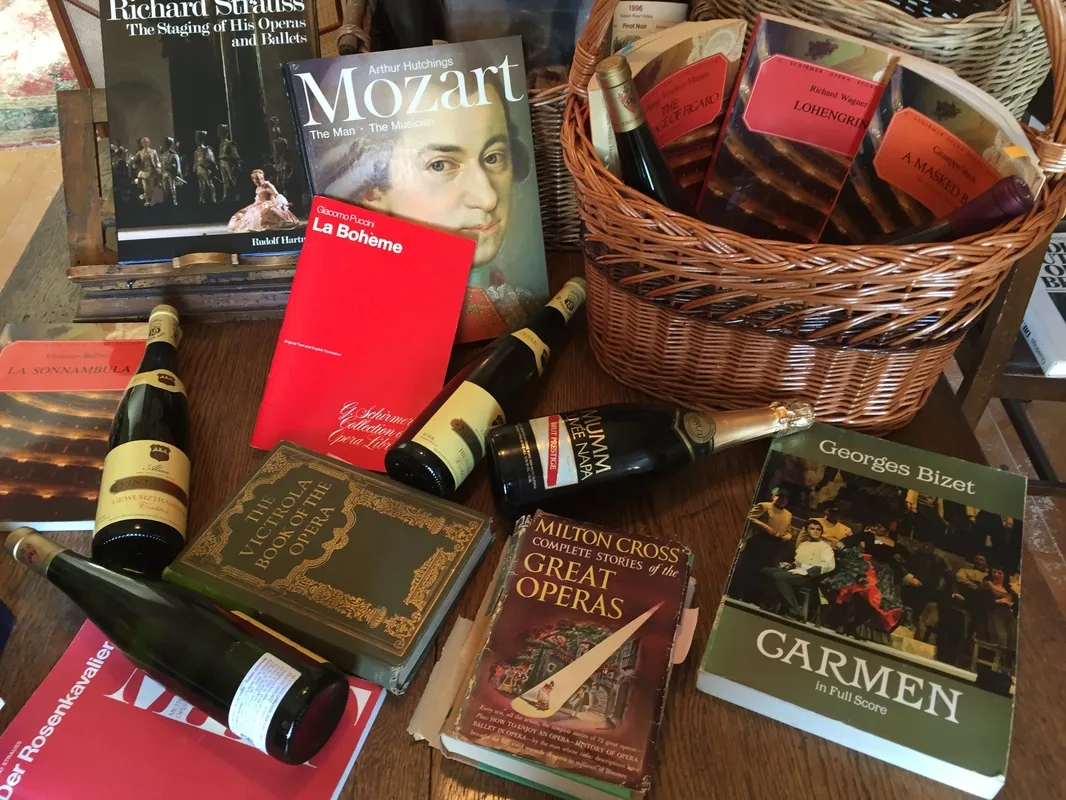
    I am so excited about my new series La tazza e il cantico. I'm co-writing it with award-winning wine writer Meg Houston Maker, and we're exploring matching up the great operas with wine, so you'll have a chance to learn a bit about both.

    Over the past years, the response people have when I tell them I'm an opera singer has changed. The kind of person who used to respond by saying "I've never been to the opera," now sometimes says instead, "oh, I go to the Met HD series, and I love it!" Their tone is often surprised, as if they never thought of going, but now that they are, they love it.

    That's a pretty exciting shift, and this series is, in part, inspired by that greater access to these great works, so we'll be syncing up our choices with operas featured in this season's choices in theaters.

    We start with Il trovatore. 

    For those of us who love opera, it stands at the center of our lives, it's a big part of what we use to sustain and enrich our lives. And I imagine the same is true for wine and wine lovers. I never like the idea of the arts as a side dish, the first thing on the chopping block when budgets are tightened. And I loved thinking about this series. It felt like moving opera into a more central conversation. Wine played a big role in the lives of the great composers, and the audiences they wrote for. I enjoyed learning more about that for this Overview Essay.

    The stories of opera are our stories, and I will really try to convey the essence of those stories in a short essay, and Meg will pick the wine, giving us the low-down on it, and how it fits the bill. I'm looking forward to being educated by her.

    Tannhäuser is in the pipeline and I can't wait to see what she picks.
    Picture

    Photo Lisa Houston