FROM THE DESK OF LISA HOUSTON
  • Home
  • Blog
  • Podcast
  • Singer's Corner
  • Dog Blog
  • Lisa's Novels
  • About Lisa
  • Contact Lisa

From the Archives: Your Christmas Without. Dealing With Loss Over the Holidays

12/24/2023

 
A Holiday post from Christmas Past.
Love and Peace to all.
​                                                                                  - Lisa
Many people have a tradition this time of year to make a gratitude list. Around Thanksgiving and into the winter holidays, people reflect, and consider all they have to be grateful for. And this is a wonderful practice. I, like many, even went through a period when I kept a daily gratitude journal, jotting down what I was most grateful for every night before bed.
            But this time of year also has a way of reminding us of winters past, and marking clearly in our minds what we have lost. Some people are facing their first holidays without a loved one who has died. Others must confront their first holiday after losing their houses to wildfires or natural disaster. Or their first holiday being divorced, broken-up, unemployed, ill, or alone. For many of us, among the losses this year has been the loss of a faith in government, or even a confidence in fundamental public decency. News from many parts of the world is deeply troubling, and for some a sense of certainty or hope has been lost. For many, it has been a rough, painful year.
​             

In this season of list making, I bristle a bit at the idea that a “best of” list has more value than a “worst of” list. More and more as life takes its toll, my idea of optimism is not to “focus on the positive”, but to love, as Zorba the Greek said, “the full catastrophe.”
            
I think there is a way of looking at loss that can have almost the same result as a gratitude list. It’s a different route to the same destination. Here’s what I mean.
One New Year’s Eve, I was performing in a musical show. Sitting in the dressing room as we applied our make-up, the actress next to me said, “I can’t wait for it to be next year.”
            
“Why?” I asked.
            
“Because,” she said, studying herself in the glass, “next year will not be the year I got divorced.”
            
Some events are so challenging, they come to define us. There was before, and after, and we are forever changed. And sometimes, as the year wraps up, we feel as if we will drown in the choppy waves of that change. As with my stage colleague, we may not deny the fact of a horrible event, but we  are ready to let go of who we were in the face of it. And there is truth in that. Whatever recovery is yet to come, whatever new trials and tribulations next year will bring, it will not be the year _________ happened.

Sometimes, when tragedy strikes, you have to take it head on, and say look at that horrible, horrible thing that happened. You can’t not dwell on the horribleness of it. It was so, so, horrible, wasn’t it? And in that way, looking at loss can force you to come face to face with something no gratitude list can give you: a realization of your own strength. Because the more horrible the loss, the more strength you summoned. Your losses may have been horrible this year, unthinkable even. But if you’re reading this, you survived them. Yes, you did. And as we say in the theatre, bravo!
            
This holiday won’t be the same as other years. It just won’t. Will it be happy? Sad? Tiring? Confusing, miraculous, or gratifying? All or none of the above?

I suppose none of us knows.

Whatever it will be, and whatever losses you are facing, I wish you well, for your first holiday without _____________.
           
                                                                    Love,
                                                                          Lisa


                            Written in loving memory of my cousin, Greg Walsh,
​                                                 and my friend, Frank Poletti. 
​                                               2017 was the year we lost them.
Picture

Where Is Your "Root Table?"

12/22/2023

 
Picture
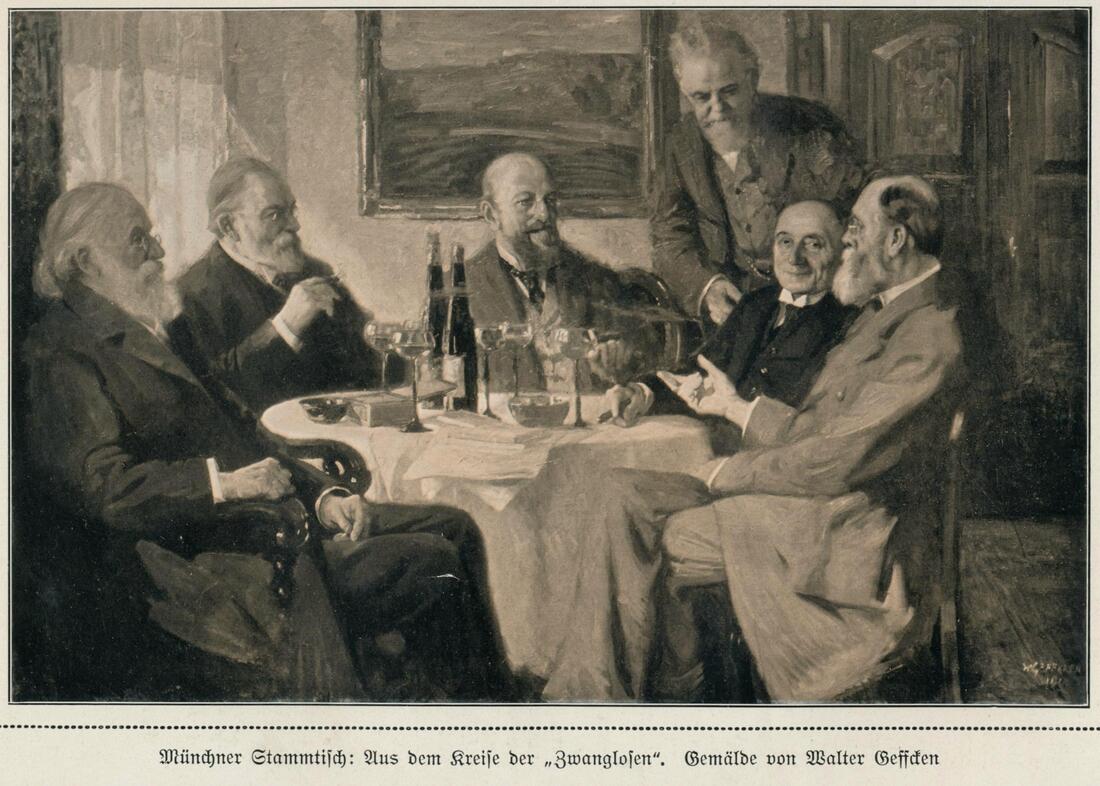
​I can set my watch by a neighbor of mine. Well in his eighties, he is a widowed man with a long white beard covering a John Muir-esque face. Winter or summer, he wears a wide-brimmed flattop hat. He walks slowly these days, using a cane, and every evening at the same time, presumably after dinner, he sets off down the hill. In winter, he carries a flashlight. He walks to the English style pub one block from our houses, where he meets a few men. They sit at the same corner table, and chat over beers for about two hours. My neighbor and his friends are harkening back to a German custom called “Stammtisch.” Pronounced Sh-tahm-tish. (The Germans like to mush words close together, like people on the UBahn.) This hybrid word means, quite literally, root-table, or regular’s table. 
            Though it refers to the table itself, which was sometimes literally a round table with the large stump or root of a tree for a base, the idea of a Stammtisch is a regular gathering. A “Treffpunkt” (meeting place) for conversation. Originally, the table was reserved local dignitaries or politicians, to gather and play cards, or discuss philosophy, politics, or important topics of the day. If a stranger innocently wandered in and took a seat at the Stammtisch, he would be shooed away to another table. The Stammtisch was exclusive, only for men, and only those of a certain rank. There is a long tradition of the Stammtisch in Germany, some of it quite sinister. Encouraging conspiracy theories at these local gatherings played a role in the growth of fascism.

            But artistic Stammtische have also flourished, particularly in the early days of coffee’s popularity, and notably in Leipzig. Café Zimmermann in that city was host to the Collegium Musicum, a musical society founded by composer George Phillip Telemann, and many of Bach’s secular works, including the Coffee Cantata, had their debuts in that space. (An exception to the “no women in the coffee house” rule was made, so women were allowed to attend these performances.) 

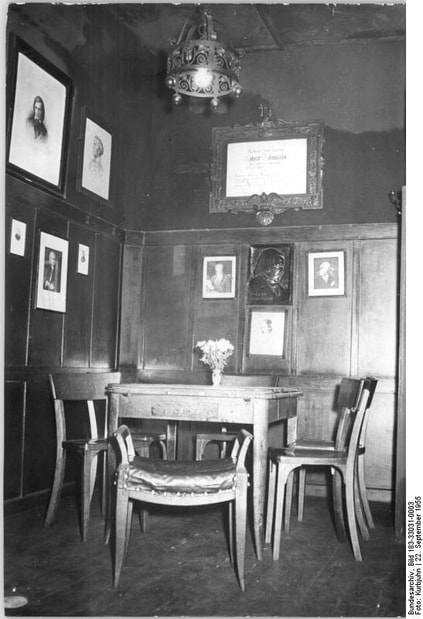
PictureTable at the Coffe Baum in Leipzig, where Robert and Clara Schumann celebrated their wedding.
​       Café Zimmerman was destroyed by an air raid in ’43, but nearby still stands another of Bach’s haunts, the Coffe Baum. (The Coffee Tree.) One of the oldest coffee houses in Europe, it is just steps away from St. Thomas Church, where Bach spent most of his life and career. And after Bach’s time, it was the root table of two other great musicians, Clara and Robert Schumann. (The building is now a coffee museum which you can visit, and see the corner booth with dark wood paneling where the couple toasted their marriage.) Goethe, Liszt, and Mahler were but a few other luminaries who enjoyed the Coffee Tree. Along with the Schumanns and their friends, there are other famous Stammtische that are artistic, rather than political. A cadre of writers first gathered at the Algonquin Hotel for lunch to welcome Alexander Wolcott home from World War One, and continued the event which became the stuff of literary legend. More broadly, the word is often used to encourage gatherings, as when my German teacher invited her students to gather at the Junket, an authentic German deli that used to be in El Cerrito, just north of Berkeley. We would gather once a month to eat sauerkraut, drink beer, and practice our German.
            But I have also heard the word used in contemporary Germany simply to mean an individual’s regular spot. The restaurant you might drop into more or less daily for breakfast, lunch, or dinner. This is your Stammtisch. A restaurant in the Charlottenburg neighborhood of Berlin, on the corner of Pestalozzi Strasse and Krumme Strasse, was my Stammtisch. Café Feliz. Run by a husband and wife, a German woman and a Turkish man, it was often their daughter who waited on me. Like the American diner, Café Feliz was an all-purpose restaurant with a deliberately broad menu. I lived nearby, and might go for breakfast and have a “Spanische Frühstuck,” a Spanish breakfast, which was diced tomato in olive oil with herbs on toast. Or I might go for lunch and have a salad or omelet, or on a cold day a big plate of “Kartoffeln ohne Speck, bitte.” Potatoes without bacon, please. Later, I might go for dinner and have a Pizza Marguerita. And still later, close to midnight, I might pop in after attending the Deutsche Oper and have a Sambucca, handily lit on fire by the same waitress who made my morning coffee. The staff was always thin at Café Feliz, with one guy in the kitchen, helped by the husband and wife, and two waitresses, at most, for the large space which also had outside tables. It would never work in America, where people are in a hurry, and the Starbucks barista apologizes t if you have to wait thirty seconds before being asked for your order. But there it functioned perfectly. Twice a week the Platz opposite the restaurant had an open air market, and on those busy days you might wait ten minutes or more before anybody got around to you, which only helped you feel at your leisure. And while the service was excellent, it was not obsequious, which was also ideal for the Stammtisch feeling. Between mealtimes I could hog a table for hours, working on a novel. The family who ran the place would take time to chat with me during the lulls. I always felt welcome.

​            I am not an intrepid traveler. I travel, but I am like the swimmer who doesn’t really like swimming, who rushes from buoy to float to shore. So finding a home base in a new city is important to me. And fortunately, I have found that Stammtisch feeling can happen in an instant, even when you’re not a local, much less a regular, and even if you visit the place only once. One rainy day near Paddington Station in London, I had an hour or so to kill before my train. I wandered around narrow, unpopulated streets until I found what I didn’t know I was looking for. My place. The entrance was about twice as wide as the door, and the whole long room was wide enough only for a counter and a man behind it moving sideways like an octopus on a wall of rocks, his arms everywhere, flipping sausages, pouring coffee, buttering toast. I squeezed onto a stool between two men tucked into full plates, their elbows on the counter, their faces— to this romantic American— Dickensian. I had an almost full English breakfast, that is eggs, beans, tomatoes, toast, but no meat. And a cup of coffee that was such a generic black liquid, it might’ve been coffee or strong English tea. It was perfect. I was fairly dressed up for the place, but still got nothing more than a fleeting sideways glance, and enjoyed my food and a sense of belonging until there was nothing but the shine of grease on the plate. 
    When I’ve had more time in a place, I have cultivated a Stammtisch more deliberately. In Paris, there was a café near a bridge, quite picturesque, I went every day. One morning a photo shoot took place on the bridge, with a handsome male model seated on a vespa. Made to order with my croissant. A book café in Vilnius was dark and unpretentious. The woman behind the bar used her downtime to make tiny, hand-carved wooden earrings. I had some tomato soup from a can, and found a ragged old copy of a Sue Grafton mystery I had read before, because a book can also be a Stammtisch. 
        When travelling, a temporary Stammtisch is a restorative. Before a day of newness, which may be hit or miss, one gains confidence that once a day, or twice, you’ll know what to expect. This is only natural. It’s what philosopher George Santayana once called “the instinct for self-repetition.” And its evolutionary. If our ancestors ate the berries of a certain bush, and were nourished and did not die, it only made sense to return safely to that same bush, rather than brave a different, unknown food source. But there’s another reason for this less adventuresome choice. You become at home in a public place, and become part of the wallpaper. You begin to feel like a local, or as if you are wearing Harry Potter’s invisibility cloak. Thus ensconced, you can truly observe. My nephew is a barista and coffee roaster in Los Angeles. He is also a writer and novelist. What a genius job for him to choose. He will never want for stories, even if he must fill in some of the details about the man with the friendly dog, or the woman who is always in a rush. 
            Much of the lure of restaurant work is to be on the inside of the Stammtisch. To be a purveyor of that sought-after sense of belonging. And it’s always a thrill for the staff when a celebrity chooses the restaurant as his Stammtisch. Kurt Vonnegut used to write and drink coffee at an unassuming cafeteria-style lunch spot called Miss Brooks Restaurant at the corner of 53rd and Third Avenue in New York. As a writer, I couldn’t carry Kurt Vonnegut’s water, but working at Miss Brooks, I did pour his coffee. In my time waiting tables at Spring Street Natural, also in NYC, I waited on the comedienne Nora Dunn. Already a star on SNL, she came in during a quiet lunch shift and didn’t speak to me at all, but left me a five dollar tip on a seven dollar salad, a gesture that said, “the service was good, and I’ve been where you are.” But any regular becomes a celebrity to the staff and, in a certain way, beloved. Even the difficult ones give the crew something to talk about, to help pass the time. And the pleasant ones are nothing less than a treasure. 
Picture
​            There is no style on a Stammtisch. It may be casual and cozy, or elite and glamorous. The British or Irish Pub is more or less a guaranteed Stammtisch. My sister plays fiddle, and has her regular weekly musical gathering, but is also always on the lookout for a place to join in and play. The Jam Session is a musical Stammtsich.  And I love to think about certain eras of the Stammtische, (the plural) like the Vesuvio Café in San Francisco’s North Beach, where the Beats hung out in the 50s, or in Broadway’s heyday, when Elaine’s and the Stage and Sardi’s would overflow with theatrical crowds, Al Hirschfeld at a corner table sketching his zigzagging lines. For a while, the coffee shop at the Edison Hotel on 47th Street was my Stammtisch. The Edison inspired Neil Simon’s 45 Seconds from Broadway, and was always a reliable place to spot stars and stage managers polishing off blintzes or matzoh ball soup before or after a show. 
But the character of a Stammtisch is not always social, or even fun. Dunn only came in the one time, but there was a regular at Spring Street Natural I will never forget. She was a young woman, still in her twenties. She always came in around dusk. She sat by the window, never ordered food, and had one glass of white wine which she lingered over, staring out the window for the better part of an hour, and then paying the bill in time to leave before the dinner rush began. “Her husband died,” my friend told me one night. A small man, this waiter had a musical accent and a gentle demeanor that inspired confidences and large tips from the customers. I almost gasped when he told me. She was so young! I had so many questions. How did her husband die? Did they used to come in together? Is this a pilgrimage? How does she fill the rest of her days, and nights? I never asked any of those questions. But I did try to bring a little more friendliness to the table on those nights when I was the one to pour her wine. 
            Long, long ago, I had my first Stammtisch, though I didn’t know it at the time. Almost daily my high school friends and I would extend our lunch hour at a place on University Avenue called Au Coquelet, where we hogged a cluster of tables pushed together at the center of the room. I’m sure we felt very sophisticated, and just as sure we talked prattle, nursing our nascent coffee addictions and discovering the joys of a simple gateau Basque. 
Perhaps my all-time favorite Stammtisch was a place in the West Village called Sandolino’s. I discovered it my first year in New York, which was coincidentally my first year of adulthood. The menu was fairly typical of a New York diner, though they had a few more items that were part of the new health food. Unlike most diners, the ceilings were two stories high, and there were many climbing plants up in the rafters. The tables were not formica, but a golden wood. Something about the decor spelled California to me, and I felt immediately at home. When a friend from Berkeley visited me at school, I took him to Sandolino’s and felt proud to show him my place. When I got a new boyfriend, Sandolino’s was one of our first stops, and also a test. If he didn’t appreciate Sandolino’s, he obviously couldn’t appreciate me. (He did come to appreciate Sandolino’s, and we later married.) Years later we lived together right behind a family-run grocery store in Berkeley, ducking in the back to pick up a loaf of bread, or a bag of onions. A grocery story can also be a Stammtisch, even without the Tisch.
         The Edison’s coffee shop is now a restaurant. Strictly fine dining, no blintzes to be had. Sandolino’s closed a long time ago, so did Spring Street Natural. Café Feliz in Berlin seems not to have survived the Pandemic. And Au Coquelet is no more. But right now, I am blessed with several nice establishments nearby. The pub my neighbor enjoys has food designed to comfort, and an occasional trivia night or musical act. There’s also a rather snazzy pizzeria, and a hole-in-the-wall bakery. Like a lot of people, the housebound reality of the pandemic made me much more aware of the importance of the Stammtisch. As a single person working mostly from home, I cherish being greeted with familiarity when I stop in for a drink or a meal, or to pick up takeout. And even on the days I don’t stop in, a friendly wave from the woman behind the bakery counter as I walk by with my dogs can lift my morning spirits. I staunchly refuse to quote the theme song from Cheers, because at a Stammtisch, it doesn’t matter if everybody knows your name or not. You are the woman with the dogs, or the man who likes extra mustard. You are that important person, a regular. And on both sides, waiter and waitee, how pleasant or unpleasant we are in these seemingly transient relationships, well, it says a lot about a person. And word gets around. The next time you see Nora Dunn on TV, you might think of that big tip she left me. And did you know that my niece once waited on Meryl Streep? And she was just lovely! 
            Though it started as a privilege for the town’s elite, the Stammtisch has also been an instrument of revolution, providing steam for the Reformation through seemingly innocuous societies like Telemann’s Collegium Musicum. Berkeley’s most famous chef, Alice Waters, encountered this revolutionary spirit the hard way when she announced she was closing César’s, a casual tapas bar next door to her famed restaurant, Chez Panisse. For twenty-four years, César’s had been enjoyed and beloved by both customer and staff, who had formed a social, commercial, and gastronomic bond so strong that it seemed an outrage that the actual owner of the property might want to do something else with the space. Signs and placards were colored in. Protests in the Berkeley tradition were held. César might’ve been Alice Water’s property, but now it had become something else. It had become a Stammtisch. 
            I wasn’t a regular at César’s, but I do have an aspiration in the Stammtisch department. My image is based on someone I used to seat when I was a hostess at an Italian fine dining spot in Newton, Massachusetts. He was a slightly rumpled man. I imagined him having a difficult job, perhaps with numbers. He used to come in once a week, never wanting a table, always taking a seat at the bar, usually the noisiest least desirable one, right by the swinging door to the kitchen. He would order the fish, and have a second glass of wine but no dessert. He was always friendly and kind to the bartender, Tim, and to anyone else who happened to occupy the seat next to him. My goal is to be that kind of weekly regular, perhaps somewhere a bit fancy. I imagine I will gift myself that experience when I decide to consider myself a successful writer, which could be any day now. I will go religiously, once a week, probably on Thursdays. I’ll sit at the bar and have a particular drink, something people can recognize, and remember. Maybe the waitstaff, behind the kitchen door, will call me “Aperol Spritz.” 
            “Aperol Spritz” is here again, they’ll say. “She looks happier this week, but she’s reading Tolstoy, isn’t that an odd combination?” That’ll give them something to talk about. 

Picture

Aria Study: Menotti's All That Gold

12/15/2023

 
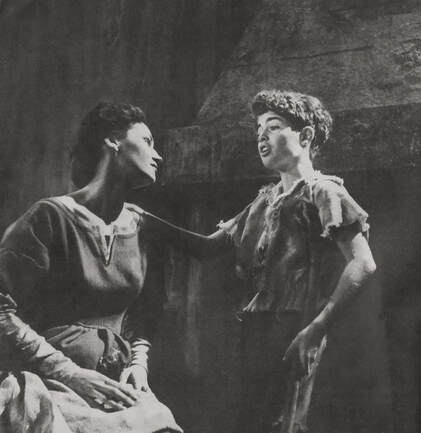
PictureRosemary Kuhlmann as the Mother and Chet Allen as Amahl in the original 1951 production for television.
​(This article is mainly a roadmap for singers wishing to perform the aria, or for anyone interested in opera.)

Should an aria from an opera written for television be performed in a way consistent with that medium, even if transported from screen to stage? Amahl and the Night Visitors, written and first broadcast in 1951, is the first ever opera commissioned for television and runs an appropriate 46 minutes. But composer Gian Carlo Menotti said he didn’t consider television at all. “All my operas are originally conceived for an ideal stage,” Menotti said, “which has no equivalent in reality.” But in the case of this aria, it doesn’t hurt to think small screen. Television is an intimate medium. Also, at this particular moment in the opera, all the other characters are asleep. The character of Amahl’s Mother is the only one awake, and we are let into her most intimate thoughts. It is a secret shared between character and audience.
         Mostly done at Christmas time, Amahl is a poignant tale for many reasons, but perhaps its most powerful essence is distilled in this moment of the Mother’s aria. The plot involves three Kings traveling to bring great gifts to a Messiah. (In the Italian Christmas tradition, “Three Kings Day” is celebrated on the Epiphany, twelve days after Christmas.) In a modest home, a poor woman cares for her child, Amahl, a bright, imaginative boy who is unable to walk without the use of his shepherd’s staff. (Think Tiny Tim goes East.) The aria asks many important questions about wealth, but it is not a merely philosophical exercise. Over the course of the aria, the Mother, through asking these questions, convinces herself that she has the right to steal some of the travelers’ gold for her the benefit of her child. 
         The aria begins with the mother’s insomnia. As Stanislavsky taught, to play a murderer convincingly, one need only to have killed a mosquito. To understand the Mother’s plight, you need only have been kept awake by one unshakable thought, obsession, or addiction. To further appreciate the Mother’s difficulty, it is important to understand what it means to live in the grip of rural poverty. The totality of it. The isolation. How often does the woman see anyone other than poor villagers like herself, subsisting in the remote desert? Perhaps she, like all of us, has thought “what if?” What if she had been born a princess? What if her son could walk? What if she were not poor?” But in such a hard scrabble life, this woman is tired, and such thoughts require energy, and probably would only take her down deeper, into an even darker place. In some situations, hope is but a tease. No, this woman is not a dreamer. She leaves the land of make believe to her son. She never imagined such a moment would befall her, but it has. She has never had two coins to rub together, and suddenly there it is. “All that gold.” It must be a mesmerizing sight to her.

PictureGian Carlo Menotti
​         Edna Garabedian, a mezzo-soprano who worked closely with Menotti and once directed me, said that Menotti could take two hours to direct two measures of music. He was that specific. Staging-wise, you can’t move around much. Someone would wake up. Again to method acting, this is like the exercise of a “private moment.” You must learn to behave exactly as if you would in private. As if there is no audience. Dynamically, the aria begins and ends quietly. It is worth saying twice, it is an intimate piece.
        Whatever you do, pick a specific point of focus for that gold. That pile of gold that is keeping you awake. See it clearly, down left, or down right, or center, but don’t let it migrate. 
       Menotti has written it low, escalating the pitch during what is a fevered dream of sorts, and then returning to the lower range to be quiet at the end, the way a dream sequence might be directed onstage, starting and ending in reality, but traveling in the imagination. Once you have established the privacy, you can fully inhabit the dream dynamically, but don’t do too much too soon, or you won’t take us with you. 
         So we begin: All that gold…All that gold…
         The gold must pull you in. It must be strong desire. If you’re not feeling it, use a substitution. What do you want so badly you might do something terrible to get it? It is this desire that keeps her awake. The gold is calling to her.
         The first question: “I wonder if rich people know what to do with their gold.” 
We could spend a thousand words on this timeless paradox. Staying in the Christmas spirit, in Frank Capra’s It’s a Wonderful Life, a man shouts down at the young lovers, Jimmy Stewart and Donna Reed, “Youth is wasted on the wrong people!” Wealth is often wasted on the rich. And the idea of the undeserving rich is as fresh today as ever. The Mother’s subtext here: The rich don’tknow the value. It is her first justification. 
         Before we go on, let’s talk about that gold. Specifically, let’s talk about the “G” in the word gold. Guh, guh, guh, a guttural sound that pulls the tongue into the back of the mouth. Not ideal for singing, right? So take care not to let the tongue get stuck there. And also, you sing the word like, a thousand times, and there’s a pile of gold right there onstage with you. Once that is established, the audience will do the work for you and hear the word gold, so you can get away with thinking of that “g” as more like a quick “c.” All that cold. All that cold. And really, make that “l” nice and quick as well, and no need to overdo the “d,” but if the “l” gets lost and the “d” gets a little breathy, you end up with all that “coat,” so don’t go too far. But especially as you go up and up and up, leave some of the “guh” behind.
         Speaking of range, is this an aria for mezzo or soprano? Menotti wrote the piece for mezzo-soprano Rosemary Kuhlmann, more on her in a bit, but the score reads simply, “soprano.” It is often done by both, and there are traps for each. The “high” note is not that high, I don’t have the score with me, but I think it’s a G, or no, A flat? Either one makes it suitable for dramatic soprano, mezzo, or even contralto. But for sopranos, the bulk of the piece lies in the lower register, and climbs upward, but then goes down again, so take care not to sing too heavily in the middle range, which will weaken the high note, nor to overdo the high note, which will cost you some of the bottom resonance you have to go back to. That was singer’s-speak for keep the voice balanced, but I hope it made sense. For mezzos, the caution would be more a matter of ego. A desire to show off too much of the rich creamy lower and middle range could cause you to be too sing-y, and ruin the mood, and as it is essentially a mood piece, not that tough to sing, you might sing it very well, but wouldn’t sell it if you over-sing. This is also one of those cases, as with Ulrica, that the quality of the high note is not really the point. Don’t tell your voice teacher I said so, but if the top not is a little shrieky, I don’t mind. The woman is desperate. And one musical note, consider the “all that” a two-noted appoggiatura. All that gold. You are constantly leaning in to the word “gold.” There is tremendous opportunity for accent and nuance with language throughout that can make or break the piece. Every word has a weight, a relative balance, with “gold” always having the most, well, value.
         Back to the question about rich people and their gold. There is a whole subset of questions to this. She sings: do they know that a house can be kept warm all day with burning logs? (Do they know?) Do they know how to roast sweet corn on the fire?...Do they know how to milk a clover fed goat? And a whole bunch of other things you have to get in the right order. Memorizing is fun! Picture each situation clearly, and always in order, a child can be fed, a house kept warm, sweet corn on the fire, a courtyard with doves, a clover fed goat, hot wine on cold winter nights. Again and again and again, which will only help the obsessiveness. And the “do they know?” interjected between each question shows the woman’s urgency. Is she asking God? Can he hear her? Will anyone answer?

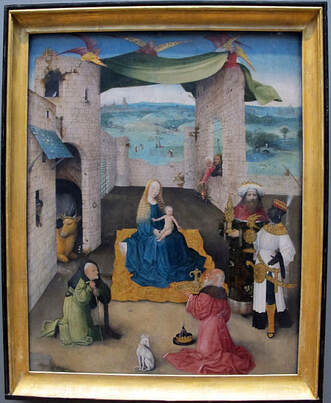
PictureHieronymous Bosch, The Adoration of the Magi
            It is a rhetorical question. Rich people have servants to put logs on the fire, and to spice the wine, so no, they don’t know. So the question behind the question here is, why did God give all the gold to the rich people, instead of to me and my needy son? We’ll get to that question a bit later.
         First, after the logs and the corn and the doves, the Mother returns to the lure of the gold, her obsession. It is a psychological leitmotif. All that gold. All that gold. Stronger every time she returns to it. (Some people say there are a lot of repetitions in Mozart, others say there are none, because you should never sing something the same way twice.)
         And now to the heart of the matter: “Oh, what I could do for my child with that gold!”
         And then another question. (Even with the rhetorical questions, make sure you really ask. She needs to go through these motions to justify stealing the gold. She has to put up a good fight within herself.) Now she asks, “Why should it all go to a child they don’t even know?” And quickly thereafter she observes, “they are asleep.” (Where onstage are they? Place them from the start, and to make things clear, put them on the opposite side from the gold. Gold downstage left, perhaps, people upstage right.) 
So, they are asleep. Now the final question, and really ask it, “Do I dare?”
         And the final rationalization, she’s gaining courage, steeling herself for the act. “If I take some, they’ll never miss it.” 
         “For my child,” she repeats several times, reminding herself of the purity of her motive. And here you must include one gesture, the reaching out of your hand so that someone can grab your wrist and cry “thief” when the aria ends. 
         But as for all those “for my child”s, I wouldn’t do any acting here at all. The relationship to the lyric and the meter is not exactly what you might think, and you need to count. “For my child,” -count beats- “for my child,” -count more beats- etc. The counting will give your face all the focus and concentration it needs. And you needn’t much voice. The fevered dream is over and you must ground us again in this intimate, made-for-TV moment. The others are asleep, you must now take action, for your child. 
       Menotti, like  other great composers, leaves a lot of clues in the music, text, and situation,
. and I hope my thoughts are consistent with his intentions, but as  always, these thoughts are offered only as food for thought, and to get your own creative juices flowing. Opera is art, not science,  so take what you like here, and leave the rest.  Your interpretation will be yours to discover.

Some History about the Opera and the Singer:
 
      This opera came on the heels of Menotti’s The Consul, which ran on Broadway and won the Pulitzer the year before. It was commissioned by NBC in 1951. Way back in ’39, NBC also commissioned Menotti for the first opera written for radio, which was to be The Old Maid and the Thief. 
     Imagine the excitement mounting for this first-ever TV opera, especially as Menotti, a notorious procrastinator, delayed and delayed. Fortunately, his procrastinations took him to the Metropolitan Museum of art, where reportedly he saw Hieronymous Bosch’s painting The Adoration of the Magi, and got inspired. The performance was given on Christmas Eve, with the NBC Symphony’s conductor, Arturo Toscanini, at the podium. 
        The role of the Mother was originated by mezzo-soprano Rosemary Kuhlmann. A native New Yorker, Kuhlmann was 29 at the time of the first broadcast. Born in 1922, she was just in her early twenties during WWII when she joined the WAVES, studied Morse code, and sent secret messages. After the war, she went to Juilliard as part of the GI bill. Not much of a fan of opera, she was singing with the Robert Shaw Chorale when an audition to take over the role of the Secretary in the Broadway production of The Consul came up. She got the role, and later auditioned for Menotti for the role in Amahl.   For the audition she sang Voi lo Sapete, the mother’s aria from Cavalleria Rusticana, it is a dramatic aria that builds from the bottom, similarly to All That Gold. According to Kuhlmann, Menotti said, “you’re a little young, but we’ll make you look like a biblical woman."
​          Later, he called to ask her, “what’s your good high note?” To which she replied, an A, which he made the high note for the Mother’s quartet with the kings. After Amahl she had other operatic successes, notably taking on the major role of Magda Sorel in the Consul, singing with New York City Opera, and continuing to play the Mother in the annual televised performances of Amahl for a decade or so. She retired to raise a family, and later worked as an executive assistant to a VP at Pepsi. 
         Rosemary Kuhlmann died in 2019 at the age of 97. Because of her service in the war, she was buried with military honors. Among her cherished memories must have been the moment after the broadcast in ’51, when she walked into Rockefeller Center’s iconic supper club, the Rainbow Room, and received a standing ovation.

​See Rosemary Kuhlman in the Original Staging of the Aria Below

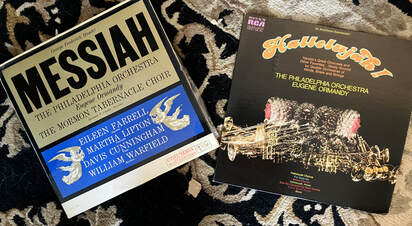
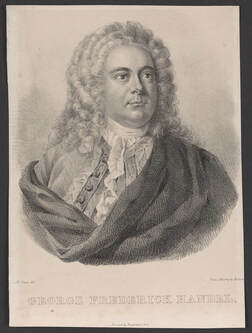
Gentlemen, Leave Your Swords at Home!                                  Five Fun (and not so fun) Facts About Handel’s Messiah

12/8/2023

 
Picture
1. Handel’s Messiah is the only piece of classical music that is routinely turned over to the audience. 
     The history of the Sing-along Messiah, also known as a “Scratch Messiah” and a “Messiah Sing,” is a bit difficult to pin down. Since its premier in April, yes April, in 1742, productions of the English language oratorio for soloists, chorus, and orchestra have taken all shapes and sizes. The Great Handel Festival of 1857 sported a chorus of thousands. (725 sopranos, 719 altos, 659 tenors, and 662 basses.) Held at the Crystal Palace, an enormous cast iron and plate glass structure with an organ of more than 4,000 pipes, it’s a wonder none of the glass shattered from the high notes. I do question whether the nearly four thousand Handel Festival singers were all “professionals” by a verifiable standard. As a business proposition, maybe some were paid in beer, so perhaps that should be counted as the first sing-along. In the States, the singalong seems to have gotten going in earnest in the 1960s. Named like the popular protest “Sit Ins” of the day, the National Chorale claims its Messiah “Sing-in” is the longest running in the country. Now in its 56th year, they will perform this year at Lincoln Center’s newly restored David Geffen Hall. 

2. Some of the text of Handel’s masterwork is antisemitism at its most pure and unapologetic. 
     We love the uplifting message of Messiah. Humanity shall be saved! But what do we need saving from? You guessed it, the Jews. The scholarship of Michael Marissen, author of Tainted Glory in Handel’s Messiah, leaves little room for doubt that the libretto, adapted by Charles Jennens from biblical passages, is intended as a call to action, that so-called heathen nations must be vanquished. Another author on the subject, Robert J. Elisberg, imagines librettist Jennens in hell, enduring a frustrated eternity because his alarmist message has morphed in to a yearly, all-inclusive love-fest. 
     As a Messiah veteran and a Jewish singer who has sung professionally in churches from Catholic to Christian Science, I know from personal experience that one must always take religious lyrics with a healthy grain of kosher salt. You have to do some substitution to sing “How Beautiful are the Feet?” convincingly. But there’s really no question that the glorious unity of old was at the expense of the perceived villainous Hebrew race. A poignant fact for today, though it cannot, as with Wagner’s personal and thematic antisemitism, nullify the power of the music. (Thank heaven for small mercies.) But yes, as satirical songster Tom Lehrer might have put it: Fa la la la la, “and everybody hates the Jews.”
     If you find this line of inquiry distressing you are not alone. After finishing his book, Marissen said he needed to take a break from religious topics, and would begin work on a general reader’s introduction to Bach. And if you are still upset, I can’t do better than to quote the title of Elisberg’s article: You Can’t Handel the Truth.

PictureSusanna Cibber
3. Contralto Susanna Cibber’s story is one of redemption and greatness. 
     The sister of composer Thomas Arne, Cibber was admired by Handel and others for a rich and agile voice, but in 1741 she was in the throes of a PR problem. Having left an abusive husband to have children with another man, her husband sued. But as the husband in question seems to have only been after his wife’s money (a story sadly repeated in the lives of many great singers across history) sympathy for the “wronged” man was limited. Handel’s casting of Cibber as alto soloist for the premier performance of Messiah, which took place in Dublin, seemed to secure her redemption. The poignance of her singing in the great lament, He Was Despised, is said to have moved the chancellor of St. Patrick’s cathedral to declare all Cibber’s sins forgiven. The English theater owes Handel a great debt for bringing Cibber back into the fold. After Messiah, Cibber returned to London, where she became one of the greatest tragedians of the day, gracing the Drury Lane boards as leading lady opposite David Garrick. 

Picture
4. The Messiah premier marked a turning point for the better in Handel’s troubled career. 
     In 1741, Handel was having a tough time of it. Treading water if not drowning in debt, he was also recovering from a stroke, and his operas were failing to meet the changing tastes of London audiences. He took the text provided by Charles Jennens, and holed himself up for twenty-four days and wrote Messiah. Hoping for a change of luck, he welcomed an invitation from the Lord Lieutenant of Ireland to perform a series of concerts in Dublin. Messiah was an add-on, squeezed in between those other concerts. As rehearsals opened to the public, interest grew. Perhaps because there was not much going on the Dublin stage during Lent, and perhaps because many wanted to get a look at the notorious Susanna Cibber, a large crowd was anticipated. To make room for the crowds, women were asked not to wear their hoop skirts, and the gentlemen were asked to leave their swords at home. The space, with capacity for 600, squeezed in 700 Dubliners. 
     Despite his own travails, or perhaps because of them, Handel cared deeply about those living in poor health and poverty, and the performance was held to benefit three charities. The prison debtor’s relief, a hospital, and an infirmary. Many were thrilled by Messiah’s success, but perhaps none more so than the 142 men freed from debtor’s prison by the proceeds. A repeat performance in June was offered for Handel’s benefit, and as a farewell to the composer before his final return to London. When he died, Handel left what had by then become a great fortune to charity.
     Since 1992, every April 13th on Dublin’s Fishamble Street, an open air performance of Messiah takes place to commemorate the premier of this great work, and the city’s place in musical history. 

PictureThe Roches
5. People of a certain age learned Messiah’s Hallelujah Chorus from a trio of sisters called the Roches. 
     Their eponymous album was played incessantly in our household, with wonderful tunes delivered in steely-voiced three-part harmony. The sisters’ rendition of Hallelujah Chorus made a smash on Saturday Night Live in 1979. There have been many exquisite versions of this chorus, and there are many more to come, but to this author none could better the taut, sincere, and utterly musical rendition of those three women. One of its most distinctive features is the tune up, three notes sung on “ah” as the sisters adjust their harmony. 
     A Handelian anecdote: one day many years ago, my then-husband and I happened to be in North Hampton, Massachusetts, (also the home of a long-running Messiah Sing.) We were walking down the main street past a small nightclub in the middle of the afternoon when we heard those unmistakable three notes ring out. “Ah!” “Ah!” “Ah!” It was like a divine visitation, a moment of musical history stepping out of time and falling upon our ears through the open door of the small venue. We stopped and looked at the poster advertising the act performing that night. Yes. We’d just heard the Roches doing their sound check. 
 
I’ve been soloist for a few Messiahs in my day and it is an odd experience, but delightful, when the audience suddenly stands up and joins in. In one local Messiah I did, at Unitarian Universalist Church of Berkeley, we all wore period costume, with Conductor Brian Baker looking quite a lot like Mozart in his white wig and satin britches. Like choruses around the country, UUCB’s Messiah Sing will be held this year. 
The tradition goes on. 
 
Some links for those with further interest:
 
My interview with conductor and Handel expert Jeffrey Thomas Here.
 
The Roches sing Hallelujah on SNL Here.
 
A wonderful five-minute documentary on the scandalous contralto Here.


Little Books, Big Wisdom

12/1/2023

 
Picture
In 1989 I was working at a bookstore in San Francisco when a slim volume of homespun philosophy hit the shelves. All I Really Need to Know I Learned in Kindergarten by Robert Fulghum jumped rather than climbed onto the best seller list, where it remained for more than a year. The collection of brief essays suggested that we would all be better off if we remembered the lessons of childhood: share everything, don’t hit, clean up your mess. And every day be sure to sing, dance, paint something, and take a nap. 
         At the time I had no use for that book, nor anything like it. The ordinary did not interest me. I felt myself on the verge of an extraordinary life. But the popularity of the book provided diversion to the bookstore staff. Perched on a walled platform in the center of the store, we quite literally looked down upon the well-dressed visitors who came in to browse before the opera, and the locals who came in search of the latest thriller or literary prize winner. Every bookseller knows the feeling of trying to help a person who knows exactly the book they want, they just don’t happen to know the title, or the author. In those pre-digital days, we flipped through slippery pages and scanned the lilliputian typeface of an enormous volume called simply, Books in Print, to try and help them find what they wanted. For an entire year people came in asking for Fulghum’s book. The problem was the name. People couldn’t get it right. “There’s a book about kindergarten,” they’d say. Or, “I’m looking for a book called, ‘Everything I Really Want I Already Had But Didn’t Know It.’” And we would try not to laugh, until one day we completely lost it when a woman came in and demanded a copy of that popular book, “you know, the one about the first grade!” 
       Fortunately, my disdain for little books of wisdom like Fulghum’s did not survive. At various times since, I have fallen in love with many books one might loosely categorize as Spiritual Self-Help. The Four Agreements. The Seven Laws of Spiritual Success. Authors like Wayne Dyer and Eckhart Tolle. When I divorced, a little book called How to Survive the Loss of a Love offered granular advice on self-care that got me through some very tough days. But for a time I still resisted the mother-of-them-all. Chicken Soup for the Soul. I had read something about a shady marketing plan that moved the book to best seller status, and I decided (without reading a word of the book) that it was not for me. 
       Then I decided to move to Berlin. My brother came to bid me goodbye at the airport and gave me a tattered copy of, you guessed it, Chicken Soup for the Soul. I took it with me. Not to read, but as a symbol of my brother’s love. About six months later, the moment came. I don’t remember what happened that day. Another audition, another rejection, perhaps. An unwelcome longing for the boyfriend I’d left behind. I don’t know. But something inspired me to pick up that book. I sat on the floor under ceiling-high windows, the half-hearted Berlin winter sunlight falling on the page as I read story after story, tears streaming down my face. 
     I loved it. And I’m not alone. The Chicken Soup franchise is thriving. Thanks to my sister, I now have a copy of Chicken Soup for the Sister’s Soul. And those who know me will not be surprised to learn I also own Chicken Soup for the Dog Lover’s Soul. They may be the airplane reading of the spiritual liturgy, but 
I have come to cherish the kind of books I once dismissed, and  I will always make room for them on my bookshelf.
       The year Fulghum’s book came out, cable news was taking root. CNN’s coverage of the fall of the Berlin Wall ushered in the 24/7 News cycle, and the digital information superhighway that would change our lives forever was being constructed. In Kindergarten, Fulghum compares the feeling of consuming too much “high-content information,” to the shuttering of his old car’s engine after being given a high octane fuel. He said it gave him the “existential willies.” 
      These days, many of us have the existential willies. We read, watch, and scroll a lot. We are less in danger of being uniformed than we are of losing ourselves in chaos and misinformation. 
      Jack Kornfield, the author of another gem of a book, After the Ecstasy, the Laundry, used to give a talk every Monday night at a meditation center in West Marin. Many Mondays I made the drive to hear him. Though his talks were profound, and for me often revelatory, he usually began by reminding the hundred or so of us who had gathered, that he wasn’t going to tell us anything we didn’t already know. His talks, like Fulghum’s book and the Chicken Soup stories, are not diatribes. They are gentle reminders. They bring us back to ourselves, sometimes after a long, unconscious hiatus. When we hear their words, we pause. We feel seen, because for a moment, in the midst of life, we see ourselves.
      Those moments can last a lifetime. My parents, who are almost ninety, still talk about a book from the 50’s called, The Lonely Crowd. It helped them to frame and understand their experiences coming of age in mid-century America. From Montaigne to The Subtle Art of Not Giving a F*ck, books and blogs on how to live a better life come and go. Some are remembered, some forgotten. But for someone, somewhere, they provided the right idea, in the right way, at just the right time. 

Picture

    RSS Feed

    Archives

    December 2024
    January 2024
    December 2023
    October 2019
    May 2019
    June 2018
    December 2017
    August 2017
    March 2017
    February 2017
    July 2016
    February 2016
    November 2015
    October 2015
    September 2015
    May 2015
    March 2015
    February 2015
    November 2014

    Categories

    All

    Blog

    Stuff that's on my mind about books, movies, opera, dogs, and life. 

  • Home
  • Blog
  • Podcast
  • Singer's Corner
  • Dog Blog
  • Lisa's Novels
  • About Lisa
  • Contact Lisa